









Canadian E-Waste Statistics: Most of Us Replace Electronics That Still Work
Nearly two-thirds of Canadians replace electronics that still work. The latest Canadian e-waste statistics from Waterloo, Statistics Canada and the UN, with every source linked.
Sixty-four per cent of Canadians replace their electronics for reasons other than the item breaking down or becoming obsolete, according to a University of Waterloo study published in March 2026. Nearly two-thirds of us replace electronics that still work.
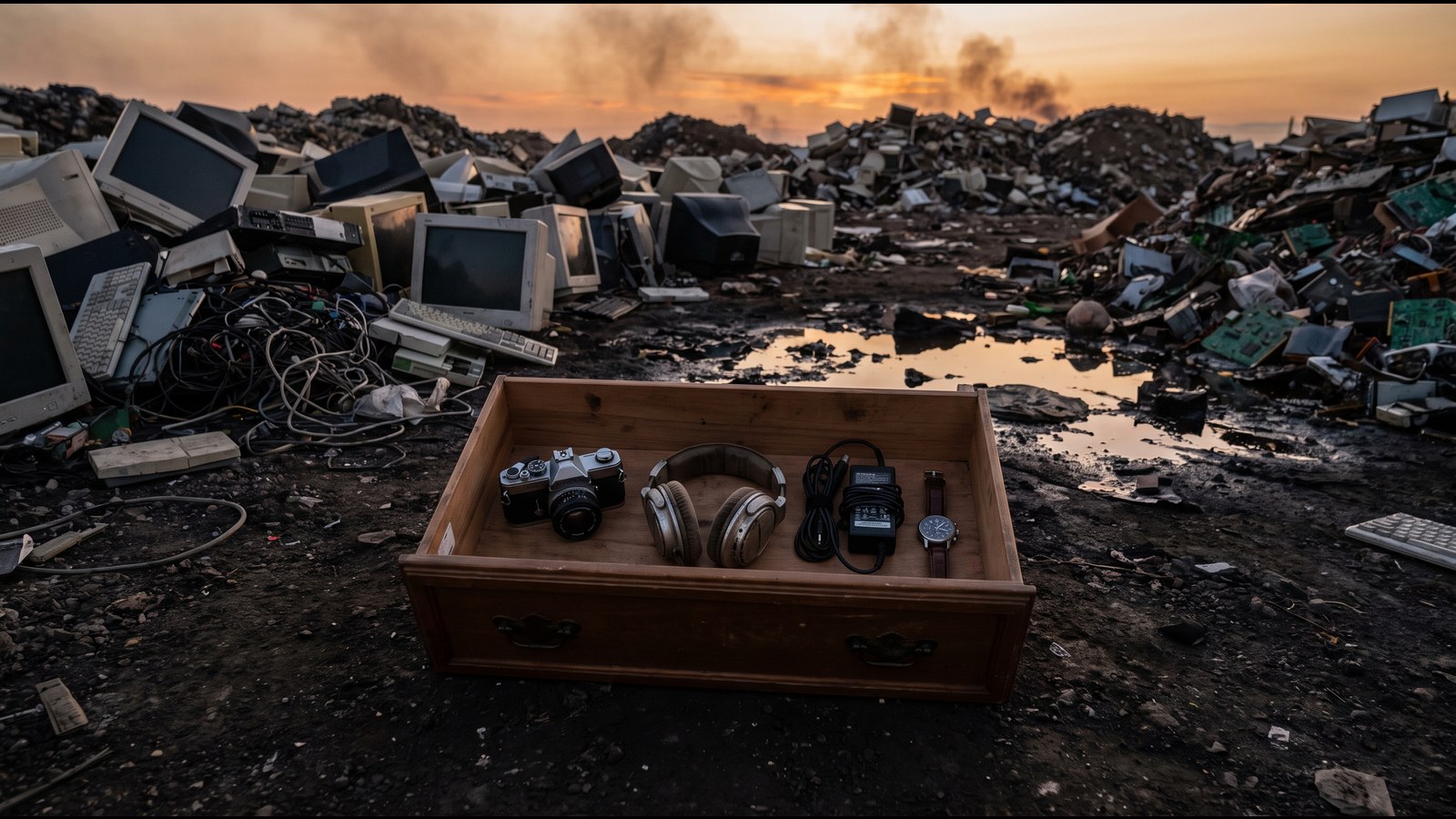
We made a short film about where a lot of those electronics go first. Not the pile. The drawer.
Why do working electronics stay in the drawer?
Open the drawer everybody has: an old laptop, a camera from a trip in 2019, a watch nobody charges. Nothing in there is broken. All of it is stuck.
Buying something new takes two clicks. Selling the same thing once you're done with it is still a mess: you don't know what it's worth, every offer is a different number, and you either meet a stranger in a parking lot or spend three weeks making sure you don't get scammed. Trading it toward something new only works in the right store, with the right thing, for a straight upgrade.
So the drawer wins. Not because people are lazy. Because the effort is guaranteed and the reward is a question mark.
The numbers below are the rest of the story. Every one links to its source.
How much e-waste does Canada produce?
Canada's e-waste more than tripled in two decades, from 8.3 kg per person in 2000 to 25.3 kg in 2020, close to a million tons that year (University of Waterloo, 2023). Looking ahead, seven everyday products, from laptops and televisions to fridges and laundry appliances, will generate around 2.3 million tons from 2025 to 2030, enough to fill 18 CN Towers (University of Waterloo, 2026). Waterloo reports in tons; the UN figures below are in tonnes.
Do Canadians replace electronics that still work?
Most do. The 64% comes from what Waterloo calls the first survey of Canadian consumers on how they buy and dispose of electronics, by Dr. Elham Mohammadi and Dr. Komal Habib of the Faculty of Environment, published in the Journal of Cleaner Production. It measures why people replace things, not the condition of what they get rid of, but the answer is plain: for most of us, the old one still worked.
How many Canadian households have electronics to get rid of?
In 2023, one in six households (16%) had unwanted small appliances, and 14% each had unwanted computers, televisions and cellphones (Statistics Canada, 2025). Some of it never leaves the house: among households with an unwanted cellphone in 2021, 38% still had it at the time of the interview (Statistics Canada, 2025). That's the drawer, in a government table.
How much of the world's e-waste is recycled?
Less than a quarter. The Global E-waste Monitor 2024, from the UN's ITU and UNITAR, counted a record 62 million tonnes of e-waste in 2022, and only 22.3% was documented as properly collected and recycled. E-waste is rising by 2.6 million tonnes a year, five times faster than documented recycling, and is on track for 82 million tonnes by 2030.
What should you do with electronics that don't work?
Recycle them. Recycle My Electronics lists drop-off locations across Canada, and most households already use them: in 2023, 64% of households with unwanted computers took them to a depot or drop-off centre (Statistics Canada, 2025).
Recycling what's dead isn't the hard part. The hard part is everything in the drawer that isn't.
That's the problem we're working on.
Got something in your drawer that still works?
- Sell it for cash, paid by Interac e-Transfer, anywhere in Canada.
- Trade it in for a gift card or other store credit at one of our partner stores.