







How to Sell Your Old Phone Without Dealing With Online Classifieds
No listings, no lowballs, no parking-lot meetups. What selling on online classifieds really costs, and a faster way to get paid for your old tech.
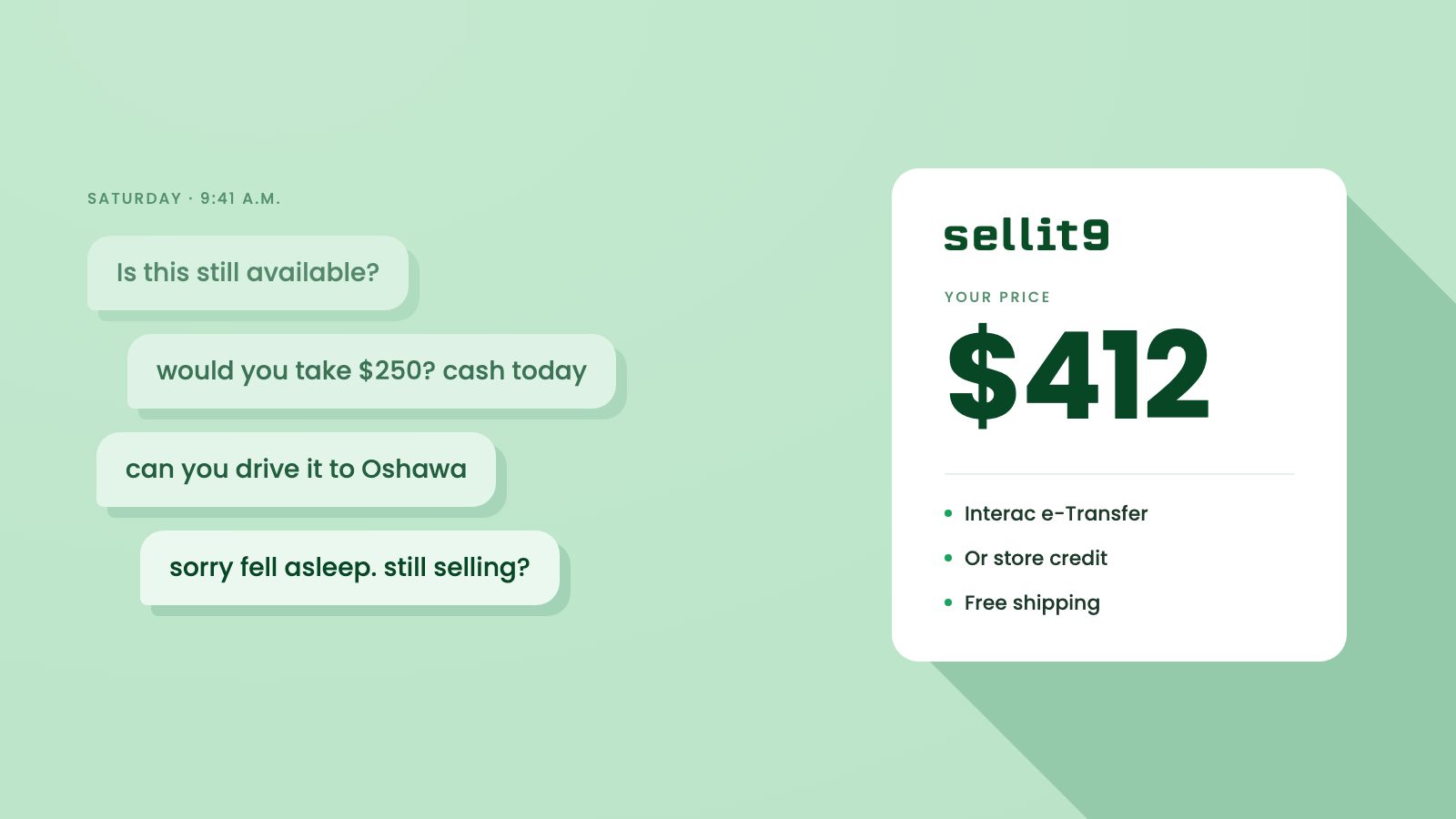
You know the routine. Wipe the phone, take eight photos in good light, write a listing, price it a little high because everyone lowballs anyway. Then the messages start. "Is this still available?" Twelve times. Three people negotiate hard, one finally agrees, and Saturday afternoon you're standing in a Canadian Tire parking lot watching nobody show up.
We built SELLIT9 because that ritual felt broken. But marketplaces do still make sense for some things, so here's a fair look at both sides.
What a marketplace sale actually costs you
The listing is the easy part. Budget half an hour for photos, a description, and price research. The expensive part is everything after: days of messages, screening out the obvious scams, negotiating with three people at once, and at least one meetup that goes nowhere.
Add it up and a typical phone sale eats three or four hours across a week or two. If the private sale gets you $40 more than an instant offer, you paid yourself about $10 an hour to haggle with strangers. Sometimes that trade is worth it. Usually it isn't.
One more thing sellers tend to assume wrong: protection. Facebook's Purchase Protection doesn't cover local pickup, and Marketplace shipping isn't available in Canada right now, so essentially every Canadian deal is a local cash deal with no platform behind it. Classifieds sites don't process payments at all; their safety guides tell you to meet in person and take cash. That's not a knock, it's the design. These platforms connect you to a stranger and step out of the way.
The scam problem is measurable
The Canadian Anti-Fraud Centre logged more than 112,000 fraud reports in 2025, totalling over $704 million in losses, its worst year on record. Merchandise fraud, the category that covers buy-and-sell platforms, accounted for 2,596 reports and $11.7 million lost. And the CAFC estimates only 5 to 10% of fraud ever gets reported.
Sellers get targeted with a few specific tricks:
- The fake e-Transfer. Ottawa police called this "the hot fraud right now" in 2025: a notification that looks exactly like Interac but is actually a money request or a phishing link. Montreal police started logging the same scam a few months later.
- The overpayment. The buyer sends too much "by accident" and asks you to refund the difference before the original payment bounces.
- The verification code. A "buyer" asks you to read back a code that was texted to you. That code signs them into an account using your number.
- Counterfeit cash. York Regional Police tracked 14 cases in a few months where sellers accepted fake $100 bills, some literally marked "prop money".
And then there are the meetups that go worse than a no-show. In a single week this August, Ottawa police investigated two armed robberies tied to Marketplace deals, and now recommend doing exchanges in "safe trade zones" outside police stations. When the safety advice is to do the deal at a police station, the model has a problem.
The platforms know it, too. Meta says it removed 159 million scam ads in 2025 alone, and the big classifieds sites have been adding identity-verification badges. Both fixes concede the same point: the hard part of a marketplace is trusting the stranger.
To be clear, most marketplace buyers are regular people. But you are the entire fraud department for your own sale, and scammers count on the average seller not checking.
When a marketplace is still your best bet
Honest answer: sometimes it is.
- Furniture, appliances, anything bulky. We don't buy your couch.
- Truly rare gear with collector value. A quote engine prices a rare film camera worse than a collector who has hunted one for years.
- You want absolute top dollar and you're patient. A private sale often grosses $50 to $150 more than an instant quote on a recent phone. That's real money, if it sells, at the price you listed, to a buyer who shows up.
If none of that describes you, keep reading.
The part most sellers never see
A marketplace listing puts your phone in front of one buyer at a time, and every one of them profits by paying you less. That's the whole structure of the deal. Haggling isn't a bug, it's the product.
SELLIT9 is built the other way around. Pricing and reselling used tech is a real skill, and the people best at it already exist: refurbishers, retailers, and online stores across Canada. We built our platform around them. Behind every quote is that buyer network, and when we quote you, your phone is already matched to the buyer who values it most.
That flips the incentives. We earn a commission on the sale, so we do better when you get more. Our job reduces to two things: get you the most for your tech, and keep our buyers stocked. And here's the fun part: many of the people messaging you on Marketplace are professional resellers sourcing inventory anyway. We just connect you to that demand directly, no haggling required.
How it works
You pick your model at sellit9.com/sell, answer a few condition questions, and see your price in about 40 seconds. That price is the price. Nobody messages you "best price?" at 11pm.
Then you choose how the phone gets to us: free shipping with a prepaid QR code or label (no printer needed), or one of 84+ drop-off locations. Businesses selling in volume can book a free pick-up. We run an assessment when it arrives, and you get paid by Interac e-Transfer. If you'd rather shop than cash out, take store credit at one of our partner stores instead.
So far 4,300+ Canadians have used it, and they rate us 4.9 from 367+ Google reviews.
Side by side
- Who's on the other side: one stranger at a time, or a network of vetted buyers.
- Their incentive: pay you less, or earn a commission when you get more.
- Time to a firm price: days to weeks, or about 40 seconds.
- Haggling: constant, or none.
- Meeting strangers: usually, or never.
- Payment: cash from a stranger, or Interac e-Transfer from us. Store credit if you'd rather shop.
- If something goes wrong: you're on your own, or you write our support and a human answers.
- Top possible price: higher if you're patient and lucky, or a firm number, guaranteed.
Questions people actually ask
Is it safe to sell on Facebook Marketplace or a classifieds site?
It can be, if you treat it like a part-time security job. Meet in daylight in a public spot, or use a safe trade zone (many Canadian police stations offer monitored ones). Accept cash or a true e-Transfer only, never refund an "overpayment", and never read anyone a code that was texted to you. The Canadian Anti-Fraud Centre keeps a current list of the tricks.
Will I get more money selling privately?
Often, yes: commonly $50 to $150 more for a recent phone, if the sale actually completes. Weigh that against the hours, the no-shows, and being your own fraud department. If your time is worth anything, the gap usually disappears.
Can I sell my old iPhone in Toronto without meeting anyone?
Yes. Shipping is free anywhere in Canada, and Toronto also has drop-off locations. Wipe it, ship it with the prepaid label, get paid after the assessment.
What if my phone is cracked or dead?
If it still powers on with one defect, like a cracked screen, yes: we buy broken phones and tablets, and the quote adjusts for condition. Broken rarely means worthless. A phone that won't turn on is the one thing we can't buy yet.
The bottom line
Marketplaces are fine at what they are: a place to find one human who wants your stuff. We're a different kind of business. Our buyers need your old tech more than any individual stranger does, and we only make money when you sell. If your Saturday is worth more than the last $40, get a quote. It takes less time than replying to one more "is this still available?"