










Why Discounting Is a Conversion Trap (And What to Do Instead)
Discounting erodes margin, trains customers to wait for sales, and dents brand equity. Why it is a trap, and how trade-in commerce works better.

The discount reflex is costing you more than margin
Discounting is the most widely used conversion tactic in ecommerce, and the most quietly destructive. Every percentage point you shave off the price trains your customers to expect less, wait longer, and value your brand a little bit less each time. It is a conversion trap: a strategy that appears to drive sales in the short term while systematically eroding the economics that make those sales profitable.
The instinct makes sense. A shopper hesitates at checkout. Revenue targets loom. A 15% discount code feels like a small price to pay for a closed sale. But that small price compounds. Across thousands of transactions, it reshapes customer behavior, compresses margins, and turns your brand into something shoppers only buy on sale.
This post breaks down why discounting backfires, which specific tactics cause the most damage, and what a fundamentally different approach to conversion looks like, one that adds purchasing power to the transaction instead of subtracting price from your product.
What makes discounting a conversion trap?
A conversion trap is any tactic that improves short-term conversion rates while degrading the long-term value of each customer, each transaction, or the brand itself. Discounting qualifies on all three counts.
It trains customers to wait. Nearly 94% of shoppers say they will wait for a discount at least occasionally, and almost one-third will only buy when a discount is available. Every flash sale and promo code reinforces this behavior. You are not converting a customer. You are training them to convert only when bribed.
It attracts low-value buyers. Shoppers whose first purchase is driven by a discount are 50% less likely to make a second purchase. Discount-acquired customers have lower lifetime value, higher return rates, and weaker brand affinity. You are paying margin to acquire the customers least likely to stick around.
It shifts brand perception permanently. Consumers associate frequent discounts with lower quality. Psychological research shows that when shoppers become accustomed to sales, they stop viewing your products as premium or valuable. The perception shifts from quality and exclusivity to affordability and disposability, and that shift is very difficult to reverse.
The five discount tactics that backfire
Not all discounts are created equal, but these five are the most common offenders in ecommerce, and each one creates a different kind of long-term damage.
1. Sitewide percentage-off sales
The classic “20% off everything” promotion is the fastest way to reset your customers’ price expectations. Once shoppers see your entire catalog at a reduced price, the original price stops feeling real. It becomes the inflated number they are waiting to see crossed out. Luxury and fashion brands have been hit hardest: in 2025, up to 40% of luxury sales were discounted. The highest share in over a decade outside of pandemic years.
2. Exit-intent discount popups
When a shopper moves their cursor toward the browser’s close button and a “Wait! Here’s 10% off” popup appears, you have just taught them that hesitation is rewarded. Worse, savvy shoppers have learned to trigger these popups deliberately. The popup does not save an abandoned session. It creates a permanent expectation that leaving is the first step toward a better price.
3. Flash sales and countdown timers
Urgency-based discounting works once. After that, it trains customers to recognize that your “limited time” offers come around every few weeks. The artificial scarcity loses its edge, and you are left cycling through increasingly aggressive promotions just to match the conversion rate your first flash sale delivered organically.
4. BOGO and bundled discounts
Buy-one-get-one and percentage-off bundles increase order volume at the expense of per-unit margin. They also attract deal-motivated shoppers who are optimizing for quantity over quality. The revenue looks good on a dashboard; the margin tells a different story. And the excess inventory from overproduction to support BOGO promotions creates its own downstream cost.
5. Loyalty program discounts tied to spend thresholds
“Spend $200, get $40 off your next order” sounds like it rewards loyalty. In practice, it creates a ceiling effect where customers spend exactly enough to trigger the reward and then stop. It also conditions your best customers, the ones who would have spent $200 anyway, to expect a 20% kickback on every cycle. You are discounting your most valuable segment.
What the data actually says about discounting
The case against discounting is not theoretical. The numbers paint a consistent picture across industries, geographies, and business models.
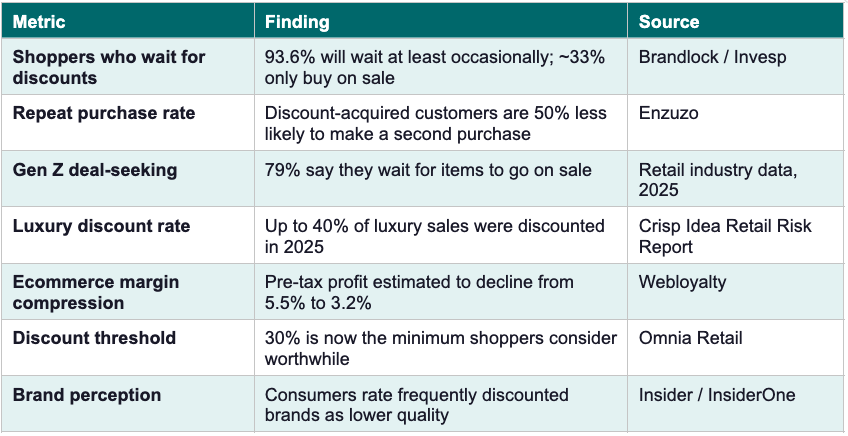
The pattern is clear: discounting does not just cost margin on the transaction where it is applied. It restructures customer expectations, compresses acceptable price points, and erodes brand equity across every future transaction.
Why discounts and BNPL both miss the point
Buy Now, Pay Later entered the market as an alternative to discounting. A way to close sales without cutting the price. And it does preserve the sticker price. But BNPL does not add anything to the transaction. It simply spreads the same cost over time, often with interest or fees that the customer absorbs (or the merchant absorbs through higher processing costs).
The fundamental problem with both discounting and BNPL is the same: they treat the customer’s budget as fixed and try to make the price fit within it. Discounts shrink the price. BNPL stretches the timeline. Neither approach gives the customer more actual purchasing power.
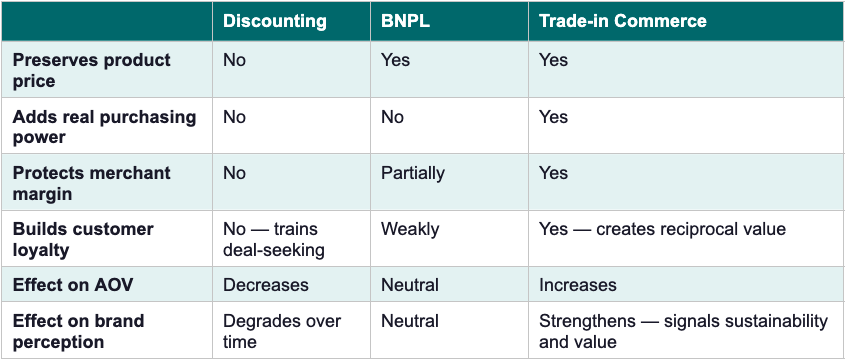
What if you could add purchasing power instead of subtracting price?
Trade-in commerce is a conversion strategy that gives customers real purchasing power by letting them trade in items they already own, phones, tablets, laptops, cameras, gaming consoles, and accessories, for instant store credit toward a new purchase. Instead of lowering the price to meet the customer’s budget, you raise the customer’s budget to meet the price.
This is not a loyalty gimmick or a payment plan. It is a fundamentally different economic mechanism. The customer brings value to the transaction that did not exist before. The merchant gets a full-price sale (often a higher-value sale, because the customer can now afford more). And no margin is sacrificed, because the purchasing power came from the customer’s trade-in, not from the merchant’s bottom line.
SELLIT9 Trade is the platform that makes this possible for any ecommerce merchant. It embeds directly into the shopping experience, on product pages, landing pages, email campaigns, abandoned cart recovery flows, and retargeting ads, giving customers the option to release value from what they already own at the exact moment of purchase intent.
Integration takes under five minutes. The widget is live on the Shopify App Store with a five-star rating, available as an Adobe Commerce / Magento extension, and supports all ecommerce platforms. Five minutes of setup is all it takes to give every customer a new form of purchasing power.
How trade-in commerce works as a conversion strategy
The mechanics are simple, and that simplicity is what makes the model scale.
Step 1: The customer sees the trade-in option. While browsing a product page (or receiving an abandoned cart email, or landing on a campaign page), the customer is prompted: “Have something to trade in? Get instant credit toward this purchase.”
Step 2: The customer describes their item. Using the SELLIT9 Trade widget, they answer a few quick questions about the item they want to trade. A used phone, an old laptop, a tablet, a camera, or a gaming console. The process takes under 60 seconds.
Step 3: They receive an instant trade-in value. The customer gets a real-time quote based on current market data. That value becomes store credit, applied directly to the purchase.
Step 4: The customer completes a higher-value purchase. With trade-in credit in hand, the customer’s effective budget has grown. They buy what they actually want, not a downgraded alternative and not a cart they will abandon because the total was $50 too high.
The result: the merchant closes a full-price (or higher-price) sale. The customer feels like they got a deal, because they did, funded by their own unused assets rather than by the merchant’s margin. And no discount code was needed.
The real alternative: give customers more to spend, not less to pay
The discounting trap exists because the ecommerce industry has defaulted to a single lever for conversion: make the product cheaper. Every flash sale, every popup, every “exclusive” promo code is a variation on the same move. Reduce the price and hope the volume makes up for the margin.
Trade-in commerce is the only conversion strategy that adds real purchasing power to the transaction. Giving customers more to spend rather than asking them to spend less or pay later. It is a model where the customer, the merchant, and the brand all come out ahead.
If your current conversion playbook relies on discounting to hit revenue targets, the question is not whether the margin erosion will catch up with you. It is when.
To explore how trade-in commerce can replace discounting as your primary conversion lever, visit SELLIT9 Trade for merchants, install the widget from the Shopify App Store, or get started on Adobe Commerce / Magento.
Frequently Asked Questions
What is a conversion trap in ecommerce?
A conversion trap is any tactic that improves short-term conversion metrics while degrading long-term customer value, margin, or brand equity. Discounting is the most common example: it lifts conversion rates today while training customers to expect lower prices on every future purchase.
Why is discounting bad for ecommerce brands?
Discounting erodes margins, trains customers to wait for sales (93.6% of shoppers will wait at least occasionally), attracts low-value buyers who are 50% less likely to repurchase, and shifts brand perception from premium to disposable. The short-term revenue gain masks long-term structural damage to the business.
What is trade-in commerce?
Trade-in commerce is a conversion model that lets customers trade in electronics they already own, phones, tablets, laptops, cameras, gaming consoles, and accessories, for instant store credit toward a new purchase. It adds real purchasing power to the transaction without requiring the merchant to discount the product price.
How is trade-in commerce different from BNPL?
Buy Now, Pay Later spreads the same cost over time but does not add new purchasing power. Trade-in commerce creates new value by converting the customer’s existing possessions into store credit, resulting in higher AOV and full-price sales with zero margin erosion for the merchant.
Can trade-in commerce replace discounting as a conversion strategy?
Yes. Trade-in commerce addresses the same core problem, a customer whose budget falls short of the purchase price, but solves it by increasing the customer’s purchasing power rather than decreasing the product’s price. Merchants using SELLIT9 Trade have seen AOV lifts of up to 90% without a single discount code.
What ecommerce platforms support trade-in commerce?
SELLIT9 Trade is available on the Shopify App Store (five-star rating), as an Adobe Commerce / Magento extension, and supports all ecommerce platforms. Integration takes under five minutes.
What items can customers trade in?
Customers can trade in phones, tablets, laptops, cameras, gaming consoles, and accessories. A customer could trade in an old phone and a tablet to put credit toward a new laptop, or trade in a camera they no longer use toward a gaming console.
How does trade-in commerce affect brand perception?
Unlike discounting, which signals that your products are not worth their listed price, trade-in commerce reinforces premium positioning. The product price stays intact. The customer perceives added value through the trade-in credit, and the transaction carries a sustainability signal (reuse over waste) that resonates with environmentally conscious shoppers.
Sources
- Brandlock / Invesp, Consumer discount behavior research: 93.6% of shoppers will wait for a discount at least occasionally. Discounting Statistics in Sales: 2025 Data & Trends
- Enzuzo, Customer acquisition and retention data: discount-acquired customers are 50% less likely to make a second purchase. Discounting Statistics in Sales
- Crisp Idea, Retail Industry Risk 2026 report: up to 40% of luxury sales were discounted in 2025. Retail Industry Risk 2026: What Could Break Models
- Webloyalty, Ecommerce margin analysis: pre-tax profit estimated to decline from 5.5% to 3.2%. How to Mitigate Declining Margins Against Rising eCommerce Activity
- Omnia Retail, Discount threshold data: 30% is now the minimum discount shoppers consider attractive. E-commerce Discounts: Types, Benefits, and Best Practices for 2026
- Pricing Solutions, Analysis of discount dependence as a growth strategy that erodes margin. Discount Dependence: A Growth Strategy That Quietly Kills Margin
- Retail Customer Experience, CX outcomes vs. price cuts for retail growth in 2026. Why CX Outcomes, Not Price Cuts, Will Drive Retail Growth in 2026