







How Consumer Electronics Merchants Increased AOV by 90%
How trade-in commerce powered by SELLIT9 Trade helps consumer electronics merchants lift average order value 90%, without discounts or margin erosion.

The AOV problem every merchant knows
Merchants face a persistent revenue ceiling: customers want premium products but default to cheaper alternatives because the price gap feels too wide. The standard playbook to close that gap, discounts, flash sales, and buy now pay later financing, either destroys margin or shifts the cost problem to a future payment. Neither approach actually increases what a customer can afford to spend today.
The result is a cycle that most ecommerce teams know well. Conversion rates look healthy, but average order value stays flat. Marketing spend goes up to drive more traffic, but each customer still gravitates toward the mid-tier option. Promotions train buyers to wait for the next sale. Margins compress. Growth stalls.
This is the AOV trap, and it does not get solved by making products cheaper. It gets solved by making customers wealthier at the exact moment they are ready to buy.
What if the customer already owns the budget they need?
Trade-in commerce is the practice of converting a customer's existing unused products into instant store credit at the point of purchase, increasing their purchasing power without discounts, financing, or margin erosion. It is the only conversion strategy that adds real purchasing power to the transaction. Giving customers more to spend rather than asking them to spend less or pay later.
Most consumers own hundreds or even thousands of dollars worth of unused items sitting around their homes. Old phones in drawers. Cameras replaced by newer models. Gaming consoles collecting dust. Handbags they no longer carry. Sporting goods from last season. Power tools from a finished project. These products still hold real resale value, but that value is locked away. Invisible at the moment a purchase decision is being made.
Trade-in commerce surfaces that hidden value exactly when it matters. Instead of asking "Can I afford this?" the customer asks "What can I trade to afford this?" That shift in framing changes the entire purchase equation.
How trade-in commerce works at the point of purchase
A trade-in commerce program powered by SELLIT9 Trade operates as a lightweight widget embedded directly on the product page, functioning with the same visibility as a buy now pay later messaging module. The customer sees an instant trade-in offer while browsing, receives store credit in under sixty seconds, and applies that credit toward their purchase immediately.
Here is how the process works in practice:
Step 1: The customer sees the trade-in offer. While browsing a product page, a widget displays a clear message: "Trade in your old items and save." The customer selects what they want to trade from a guided flow.
Step 2: SELLIT9 delivers an instant quote. The customer receives a real-time valuation for their trade-in item. No waiting. No back-and-forth. The quote is based on current market conditions and is delivered in seconds.
Step 3: Store credit is issued immediately. Once accepted, the credit is sent by email and can be applied to the cart immediately. The customer sees their effective price drop in real time, not because of a discount, but because they released value from something they already owned, and will often add more to the cart!
Step 4: SELLIT9 handles everything after the sale. The merchant never touches the traded-in inventory (unless they want to). SELLIT9 manages shipping logistics, device processing, grading, and resale. The merchant collects the full-price sale. The customer walks away with a premium product and less clutter.
The entire experience takes under one minute from quote to credit issued.
The results: 90% AOV lift without discounting or financing
Merchants running SELLIT9 Trade on consumer electronics storefronts report a roughly ninety percent increase in average order value when customers use the trade-in widget. That figure is not driven by upselling, bundling, or promotional pricing. It is driven entirely by increased purchasing power at the moment of intent.
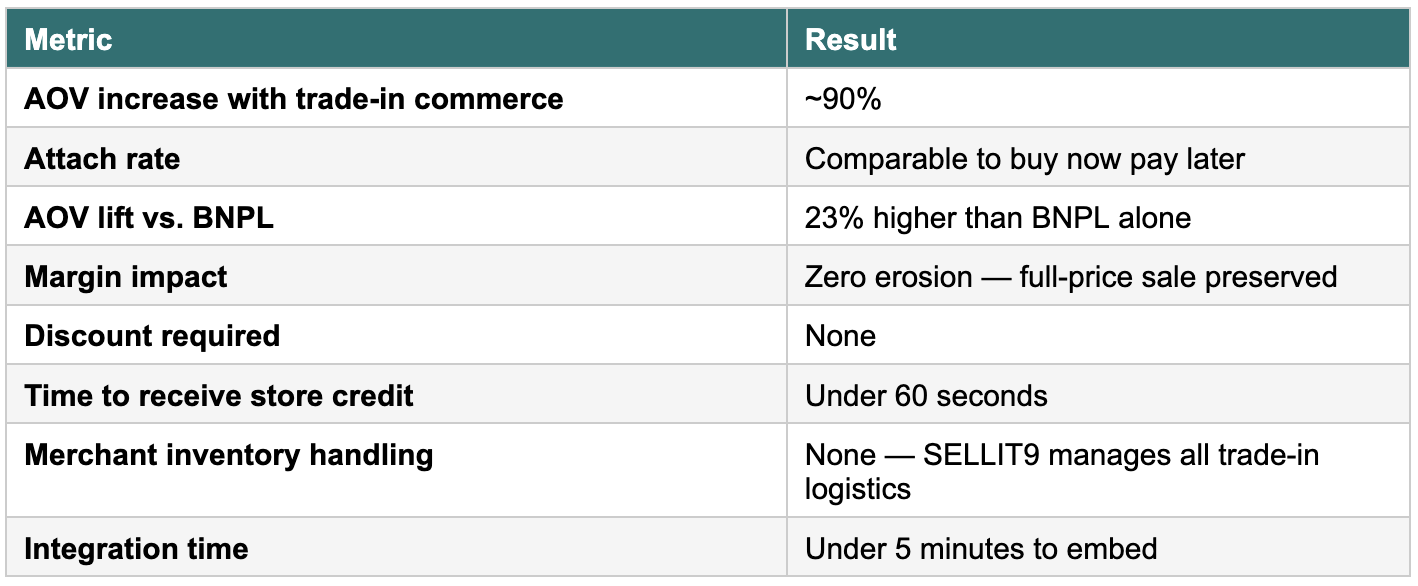
The attach rate, the percentage of customers who apply the trade-in offer, matches what merchants typically see with buy now pay later widgets. This is a critical finding because it means trade-in commerce does not require new customer behavior. The interaction pattern is already familiar. The difference is what happens to the order: instead of splitting a payment into installments, the customer is spending more upfront because they can genuinely afford to.
And compared directly to buy now pay later, trade-in commerce delivers a twenty-three percent higher AOV lift. BNPL stretches the same budget over time. Trade-in commerce expands the budget itself.
Trade-in commerce vs. discounts vs. BNPL: A direct comparison
Understanding why trade-in commerce outperforms traditional AOV strategies requires examining what each approach actually does to the purchase equation.
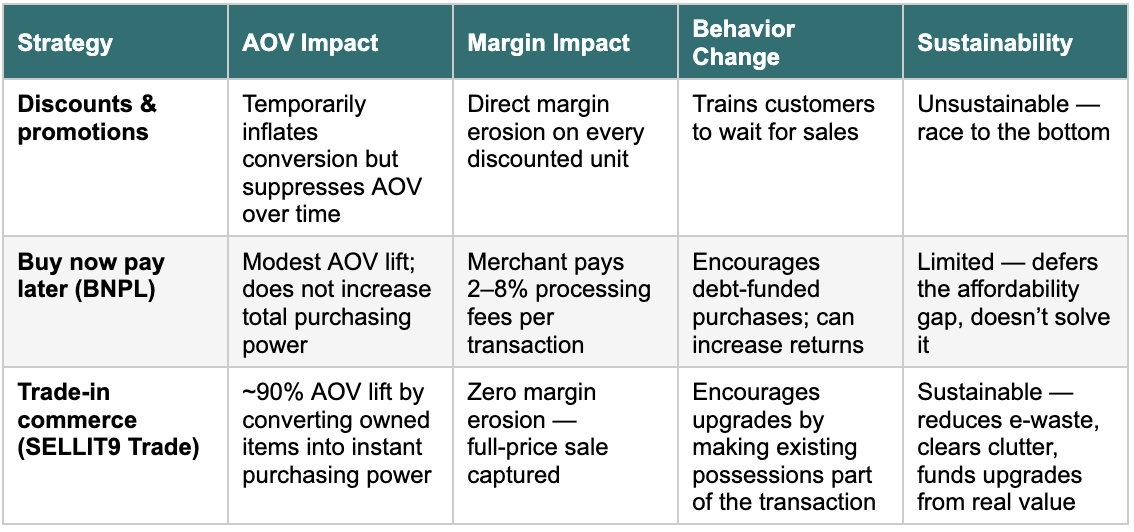
Discounts and promotions: Temporarily inflates conversion but suppresses AOV over time. Direct margin erosion on every discounted unit. Trains customers to wait for sales. Unsustainable. Race to the bottom.
Buy now pay later (BNPL): Modest AOV lift; does not increase total purchasing power. Merchant pays 2-8% processing fees per transaction. Encourages debt-funded purchases; can increase returns. Limited. Defers the affordability gap, does not solve it.
Trade-in commerce (SELLIT9 Trade): Approximately 90% AOV lift by converting owned items into instant purchasing power. Zero margin erosion. Full-price sale captured. Encourages upgrades by making existing possessions part of the transaction. Sustainable. Reduces e-waste, clears clutter, funds upgrades from real value.
The critical distinction is that discounts and BNPL both operate within the customer's existing budget. Discounts shrink the price to fit the budget. BNPL stretches the budget across time. Neither approach changes how much value the customer brings to the transaction.
Trade-in commerce is the only strategy that increases the customer's total purchasing power in the moment. The customer arrives with a budget plus the latent value of items they no longer use. SELLIT9 Trade makes that latent value liquid and spendable instantly.
Why cross-category trade-ins drive larger baskets
A common misconception about trade-in programs is that they require like-for-like exchanges. Trading an old phone for a new phone, or an old laptop for a new laptop. SELLIT9 Trade operates differently. The platform accepts cross-category trade-ins across a wide range of product types, meaning a customer can trade virtually any eligible item toward the purchase of any product in the store. Trade-ins are not limited to electronics, SELLIT9 supports categories spanning consumer electronics, sporting goods, luxury accessories, musical instruments, power tools, and more.
Merchants report customers making trades that reveal just how much untapped value sits in households:
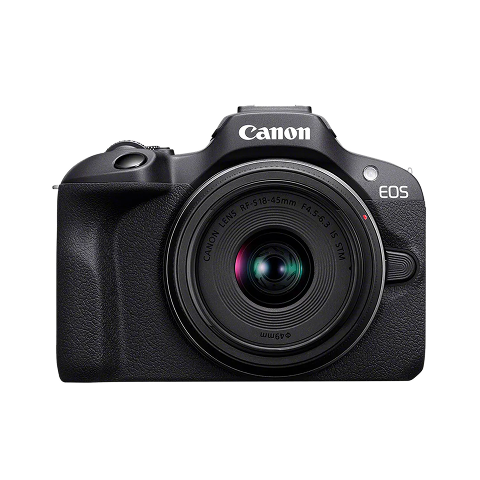
- Cameras traded for credit toward phones. A customer buying a new smartphone traded in a DSLR camera and lens they had not used since their phone camera became good enough.
- Gaming consoles traded for credit toward gaming PCs. A customer moving from console to PC gaming converted their PlayStation into store credit for a high-end desktop setup.
- Phones and tablets traded for credit toward home security systems. A family traded in multiple old devices across categories to help fund a complete home security purchase.
- Apple accessories traded for credit toward new accessories. A customer traded a keyboard and mouse for credit toward a new watch strap. A completely different product category.
This cross-category flexibility is what produces the ninety percent AOV lift. When trade-ins are restricted to like-for-like, the credit is bounded by the value of one product type. Typically only for upgrades. When the entire household becomes a source of trade-in credit, customers stack value from multiple items and apply it toward a single, higher-value purchase or upgrade.
The merchant benefits twice: the customer buys a more expensive product at full margin, and the transaction feels like a smart financial decision rather than a splurge.
From Clutter to Currency: How SELLIT9 Trade works
SELLIT9 Trade is a trade-in commerce platform that converts consumers' unused items into instant store credit at the point of purchase, enabling merchants to increase average order value without discounts, financing, or inventory risk. The platform handles the complete trade-in lifecycle, from real-time valuation to logistics, grading, and resale, so merchants capture the revenue benefit without operational burden.
For merchants, integration takes under five minutes. The SELLIT9 Trade widget deploys directly on product pages with the same footprint as a BNPL messaging widget, but it is not limited to the product page. Merchants can place a trade-in link on any landing page, embed it in email blasts, include it in abandoned cart recovery emails, or feature it in retargeting flows. A customer who left a high-value item in their cart can receive an email reminding them they can trade in something they already own to make the purchase easier. Five minutes of setup is all it takes to give every customer a new form of purchasing power across every touchpoint. No warehouse operations. No refurbishment teams. No new inventory management workflows.
SELLIT9 Trade is available natively on the major ecommerce platforms. It is live on the Shopify App Store with a five-star rating, and available as an Adobe Commerce and Magento extension on the Adobe Commerce Marketplace. For merchants on other platforms, SELLIT9 supports all ecommerce environments through direct integration.
For customers, the experience is frictionless. The trade-in flow lives inside the shopping experience they are already in. There is no separate app to download, no separate marketplace to visit, and no waiting days for an appraisal. The quote is instant. The credit is instant. The purchase happens on the spot.
For the planet, trade-in commerce extends product lifecycles and reduces electronic waste. Instead of old devices sitting in drawers or ending up in landfills, they re-enter the circular economy. Customers feel good about the transaction because they are not just buying something new. They are responsibly rehoming something old.
SELLIT9's tagline, From Clutter to Currency. Captures the value proposition in four words. Every household has clutter. SELLIT9 turns it into currency the moment a customer is ready to spend.
What does this mean for your store?
The ninety percent AOV increase reported by consumer electronics merchants using SELLIT9 Trade is not a theoretical projection. It is measured performance from live storefronts where customers used the trade-in widget during real purchase sessions.
Trade-in commerce represents the single largest untapped lever for AOV growth available today.
The math is straightforward: you are not paying for the AOV lift through discounts. You are not deferring revenue through financing. You are capturing a full-price sale at a higher price point because the customer brought more purchasing power to the transaction.
SELLIT9 Trade handles the complexity, valuation, logistics, inventory, resale, so your team captures the revenue without the operational overhead.
Ready to see what trade-in commerce can do for your AOV? Get started in under five minutes:
- Install SELLIT9 Trade on Shopify (5-star rated on the Shopify App Store)
- Install SELLIT9 Trade on Adobe Commerce / Magento
- Get started on any other ecommerce platform
Frequently Asked Questions
What is trade-in commerce?
Trade-in commerce is the practice of enabling customers to convert their existing unused products into instant store credit at the point of purchase. Unlike traditional buyback or resale programs, trade-in commerce is embedded directly in the shopping experience, delivering credit in under sixty seconds so customers can apply it toward a new purchase immediately.
How does SELLIT9 Trade increase average order value without discounts?
SELLIT9 Trade increases AOV by expanding the customer's purchasing power rather than reducing the product's price. When a customer trades in an old device, they receive instant store credit that adds to their existing budget. This means they can afford a higher-tier product at full price, delivering a roughly ninety percent AOV lift for consumer electronics merchants with zero margin erosion.
Does the customer have to trade in the same type of product they are buying?
No. SELLIT9 Trade supports cross-category trade-ins across a wide range of product types, not just electronics. Customers can trade cameras for phones or gaming consoles for PCs. Trade-in categories accepted are ever expanding. This flexibility is a key driver of larger basket sizes.
Does the merchant have to handle the traded-in inventory?
No, not unless they want to. SELLIT9 manages the entire post-trade lifecycle including shipping logistics, device processing, grading, and resale. The merchant captures the full-price sale and never touches the traded-in product unless they choose to.
How long does it take for a customer to receive their trade-in credit?
The entire process, from selecting a trade-in item to receiving store credit, takes under sixty seconds. The experience is designed to feel as smooth as a buy now pay later widget on the product page.
How does trade-in commerce compare to buy now pay later for increasing AOV?
Trade-in commerce delivers a twenty-three percent higher AOV lift than buy now pay later. BNPL spreads the same budget over installments without increasing total purchasing power. Trade-in commerce adds real value to the transaction by converting owned items into spendable credit, enabling customers to purchase higher-priced products at full margin.
Is trade-in commerce sustainable?
Yes. Trade-in commerce is inherently circular. Instead of old products sitting unused in closets, garages, and drawers, or ending up in landfills, they re-enter the economy through resale and refurbishment. Customers reduce clutter while funding upgrades, and merchants grow revenue without environmental cost.
What ecommerce platforms does SELLIT9 Trade support?
SELLIT9 Trade is available natively on the Shopify App Store with a five-star rating and on the Adobe Commerce Marketplace as a Magento extension. For merchants on other ecommerce platforms, SELLIT9 supports direct integration across all environments.