







Why Your Conversion Rate Plateaus After Your First Growth Phase
After the first growth phase, conversion optimization hits a ceiling. Why the standard playbook stalls, and how added purchasing power breaks through.

Every Store Hits the Same Wall
A conversion rate plateau is the point at which an ecommerce store's conversion rate stops improving despite continued investment in optimization, advertising, and customer acquisition. It typically occurs after the initial growth phase, the period when basic improvements to site speed, product pages, and checkout flow produce rapid, measurable gains, and it signals that the easy levers have already been pulled.
Most stores experience their fastest conversion growth in the first 12 to 18 months. You launch, you fix the obvious friction points, you add reviews and trust badges, you tighten up your checkout. Conversion climbs from 1% to 2%, maybe 2.5%. The growth feels earned and repeatable.
Then it stops.
Not because you stopped optimizing. Not because your traffic got worse. It stops because the tools that drove your first wave of growth are subject to diminishing returns, and the forces working against your conversion rate are accelerating. Customer acquisition costs have risen roughly 40% in the last two years alone. Ad auction inflation, privacy regulation, and market saturation are compounding. The same spend that delivered a 2.5% conversion rate six months ago now delivers 2.4%, and the gap keeps widening.
This post breaks down what causes the plateau, why the standard playbook fails at this stage, and what a structurally different approach to conversion and AOV looks like when the usual levers stop working.
What Is a Conversion Rate Plateau?
A conversion rate plateau is a sustained period where conversion rate remains flat or declines slightly despite active optimization efforts. It is distinct from a temporary dip caused by seasonality, a site migration, or a traffic quality issue. A true plateau persists across multiple optimization cycles and resists the standard interventions, A/B tests, checkout redesigns, promotional campaigns, that previously moved the needle.
The global average ecommerce conversion rate sits at approximately 2.5% as of Q3 2025, up 0.4 percentage points year over year. But that average masks a critical pattern: the gains are concentrated among stores investing in advanced personalization and AI-driven optimization, while the broad middle tier of ecommerce businesses has flatlined in the 2% to 3% range for over two years.
Stores converting above 3.2% rank in the top 20% of all ecommerce sites. Those hitting 4.7% or higher are in the top 10%. For most merchants, the plateau lives somewhere between 2% and 3%, and it is where growth stalls, margins compress, and the temptation to discount becomes almost irresistible.
The Five Forces Behind the Plateau
The plateau is not a single problem. It is five problems converging at the same time, and each one makes the others harder to solve.
1. Customer Acquisition Costs Are Outpacing Conversion Gains
The average ecommerce CAC has risen from $274 to $318 in 2026. A 16.1% increase in a single year. Over the past five years, acquisition costs have climbed 60%. Over the past eight years, they have more than tripled, a 222% increase across industries. Facebook CPMs alone have risen 89% since 2020, and Google Ads CPCs are climbing 12.88% year over year.
What this means for conversion: you are paying significantly more to get each visitor to your site, which means your conversion rate needs to be significantly higher just to maintain the same unit economics. When CAC rises and conversion holds flat, profitability erodes. Even if revenue looks stable on a dashboard.
2. The Low-Hanging Fruit Is Gone
The first phase of ecommerce growth is powered by fixing friction. You eliminate surprise shipping costs. You reduce form fields at checkout. You add product reviews and high-quality images. These optimizations can lift conversion by 20% to 35%, according to checkout optimization benchmarks.
But they are one-time gains. Once you have reduced your checkout to the minimum viable friction, the next 0.5% improvement requires exponentially more effort, testing, and investment. The optimization curve flattens, and each subsequent A/B test produces smaller and less statistically significant results.
3. Traffic Quality Degrades as You Scale
In your first growth phase, traffic tends to be high-intent. Early customers find you through direct search, word of mouth, or highly targeted campaigns. As you scale, you broaden your targeting, enter new channels, and increase ad spend. All of which dilute traffic quality.
Social media traffic converts at just 0.91%, compared to 3.3% for direct traffic. Mobile traffic, which increasingly dominates volume, converts at 1.8% versus 3.9% for desktop. As your traffic mix shifts toward lower-intent, mobile-first, social-referred visitors, your blended conversion rate drops. Even if your site experience is better than it has ever been.
4. Market Saturation Compresses Differentiation
Your competitors are running the same playbook. They have the same Shopify themes, the same review apps, the same urgency timers, the same checkout optimizations. When everyone optimizes for the same conversion benchmarks using the same tools, the competitive advantage of any single optimization approaches zero.
The result is a race to the middle. Stores converge on similar experiences, similar price points, and similar promotional strategies, and the only lever left to differentiate on is price. Which leads directly to the fifth force.
5. The Discount Spiral Absorbs Remaining Margin
When conversion plateaus, the reflexive response is to discount. A 15% off code here, a flash sale there, an exit-intent popup offering free shipping. These tactics can produce a short-term conversion bump, but they come at a compounding cost.
A 20% discount on products with 50% margins requires 67% more sales just to maintain the same profit. Shoppers acquired through discounts are 50% less likely to make a second purchase. And nearly 94% of consumers now say they will wait for a discount at least occasionally. Meaning every promotion you run trains more customers to delay their next purchase until the next sale.
The discount spiral does not break the plateau. It lowers the floor.
Why the Playbook That Got You Here Won't Get You Further
The standard ecommerce growth playbook follows a predictable sequence: optimize site speed, improve product pages, streamline checkout, add social proof, run targeted ads, and deploy promotional campaigns. This playbook works. Until it does not.
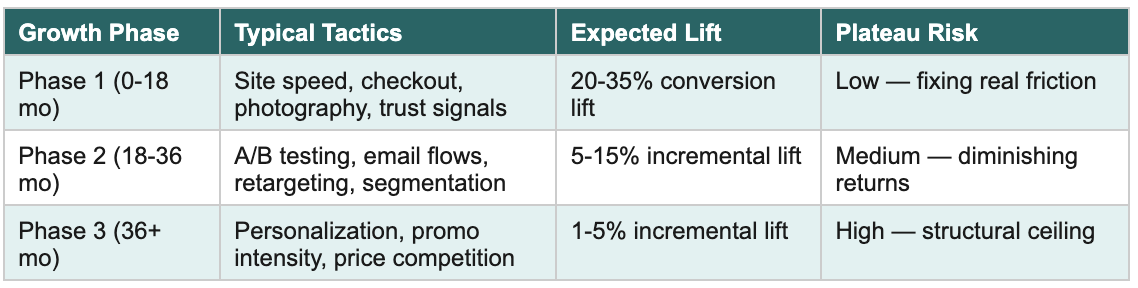
Growth PhaseTypical TacticsExpected LiftPlateau RiskPhase 1 (0-18 mo)Site speed, checkout, photography, trust signals20-35% conversion liftLow, fixing real frictionPhase 2 (18-36 mo)A/B testing, email flows, retargeting, segmentation5-15% incremental liftMedium, diminishing returnsPhase 3 (36+ mo)Personalization, promo intensity, price competition1-5% incremental liftHigh. Structural ceiling
The problem is not execution. The problem is that every tactic in Phase 2 and Phase 3 is working within the same constraint: you are trying to convert the same visitor, with the same purchasing power, on the same product at the same price. You are optimizing the experience around the transaction without changing the economics of the transaction itself.
Personalization can lift conversion by 10% to 15%, but it is optimizing which product the customer sees, not whether they can afford it. Retargeting can recover abandoned carts, but it cannot make a $400 product feel like a $250 decision. Email flows can nurture intent, but they cannot close the gap between what a customer wants and what they can justify spending.
The plateau is not a UX problem. It is a purchasing power problem.
Conversion Rate Benchmarks: Where the Ceiling Actually Is
Understanding the plateau requires understanding where conversion rates actually cluster across industries and how little they move once you pass the initial optimization phase.
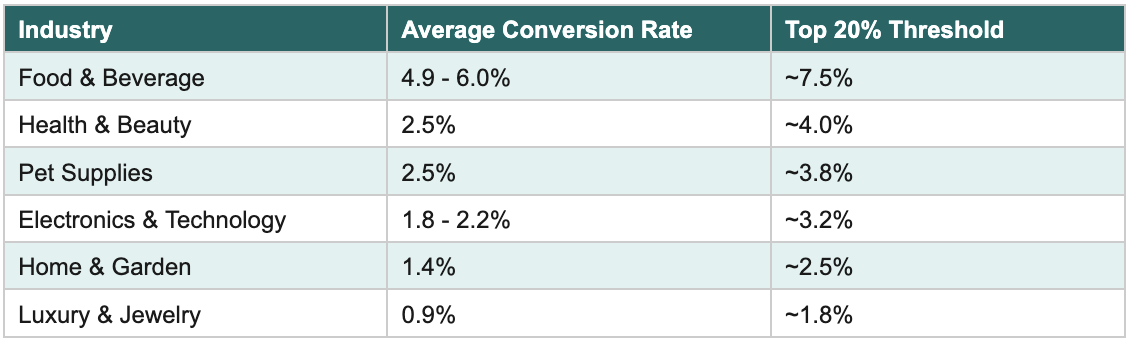
IndustryAverage Conversion RateTop 20% ThresholdFood & Beverage4.9 - 6.0%~7.5%Health & Beauty2.5%~4.0%Pet Supplies2.5%~3.8%Electronics & Technology1.8 - 2.2%~3.2%Home & Garden1.4%~2.5%Luxury & Jewelry0.9%~1.8%
Industries with higher average order values consistently show lower conversion rates. The higher the price, the harder the conversion, because the gap between desire and purchasing power is wider. The spread between average and top-20% performance is remarkably narrow in most categories. The ceiling is real, and most of the industry is already near it.
For electronics and technology merchants specifically, the category where SELLIT9 Trade is most prevalent today, the average sits between 1.8% and 2.2%. Getting from 2% to 3% in this category is not a marginal improvement. It is a step-change that requires fundamentally altering the transaction, not incrementally polishing the experience.
The AOV Problem Hiding Inside the Conversion Problem
Most merchants treat conversion rate and average order value as separate metrics to be optimized independently. In practice, they are deeply entangled, and the plateau in one is almost always masking a problem in the other.
When conversion stalls, merchants often respond with promotions that juice short-term conversion at the expense of AOV. The 15% discount code converts a hesitant shopper but reduces the transaction value. The free shipping threshold nudges the order up slightly but trains the customer to expect subsidized delivery. The BOGO offer doubles the unit count but halves the per-unit margin.
The math is punishing. If your AOV drops 10% from promotional activity but your conversion rate increases 10%, your revenue per visitor stays roughly flat, but your margin per visitor drops significantly because you are now processing the same revenue at lower profitability.
Companies that implement well-structured bundling strategies see AOV lifts of 20% to 30%, with some achieving profit increases up to 30%. And retailers that redirect budget from blanket discounts to personalized value strategies earn returns up to three times higher than mass promotions. The data is clear: the path through the plateau runs through AOV, not deeper discounting.
What High-Growth Stores Do Differently at the Plateau
The stores that break through the conversion ceiling share a common strategy: instead of trying to squeeze more conversions out of the same transaction economics, they change the economics of the transaction.
They add purchasing power instead of subtracting price. Rather than reducing the cost of the product, they increase the customer's ability to pay for it. This can take the form of trade-in credit, where a customer offsets the purchase price by trading in something they already own. A shopper looking at a $1,200 laptop who can trade in their current device for $350 is no longer making a $1,200 decision. They are making an $850 decision. The price did not change. The margin did not shrink. The customer's purchasing power expanded.
They deploy conversion strategies across the full funnel, not just the product page. High-performing stores embed purchasing power tools into product pages, landing pages, email campaigns, abandoned cart recovery emails, and retargeting flows. The message shifts from "here is a discount to close the deal" to "trade in something you own to complete this purchase." That reframing changes the psychology of the transaction, from a negotiation on price to a release of value.
They protect margin while lifting both conversion and AOV simultaneously. This is the critical difference. Discounting lifts conversion at the expense of AOV and margin. Adding purchasing power lifts conversion and AOV together, because the customer is spending more total dollars (their cash plus their trade-in credit) while the merchant retains full price on the product.
How Adding Purchasing Power Breaks Through the Ceiling
SELLIT9 Trade is a conversion strategy built for the plateau. It works by embedding a trade-in widget directly into your ecommerce experience, on product pages, landing pages, email campaigns, abandoned cart flows, and retargeting ads, that lets customers trade in items they already own (phones, tablets, laptops, cameras, gaming consoles, accessories, with additional categories added regularly) for instant credit toward their purchase.
The mechanics are simple. A customer browsing a product page sees what their existing device is worth. That trade-in value appears as a credit against the purchase price, reducing the effective cost without touching your margin. The customer sees a lower out-of-pocket price. You collect full retail. The trade-in device is handled separately through SELLIT9's logistics network.
This is not a payment plan. It is not buy-now-pay-later. It is not a discount. It is a new form of purchasing power, one that adds value to the transaction instead of subtracting it from your margin.
Conversion increases because the effective price barrier drops. A customer who was hesitating at $800 is now looking at a $500 net cost after trade-in credit. The decision calculus changes fundamentally.
AOV increases because customers with trade-in credit tend to buy up, not down. When a customer has $300 in trade-in credit, they are more likely to choose the premium configuration than the base model.
Margin holds because the product price never changed. Unlike a 20% discount that compresses your margin by 20 points, trade-in credit is funded by the value of the customer's existing device. Your economics stay intact.
Customer acquisition cost effectively decreases because you are converting a higher percentage of the same traffic. When CAC is $318 and conversion is 2%, your cost per acquiring customer is $15,900 per 100 visitors. Lift conversion to 3% with the same spend and that drops to $10,600.
SELLIT9 Trade integrates in under five minutes. It is available on the Shopify App Store with a five-star rating.
Also available as an Adobe Commerce / Magento extension.
Supported across all major ecommerce platforms. Five minutes of setup is all it takes to give every customer a new form of purchasing power.
Frequently Asked Questions
What is a conversion rate plateau in ecommerce?
A conversion rate plateau is a sustained period where an online store's conversion rate stops improving despite ongoing optimization. It typically occurs after the first 12 to 18 months of growth, once the most impactful improvements to site speed, checkout flow, and product pages have already been implemented.
Why does my conversion rate stop growing after initial improvements?
The initial improvements fix real friction and produce large gains. Once that friction is removed, each subsequent optimization produces smaller results. At the same time, rising customer acquisition costs, traffic quality dilution, and competitive convergence create downward pressure that offsets incremental gains.
What is a good ecommerce conversion rate in 2026?
The global average is approximately 2.5%. Stores converting above 3.2% are in the top 20%, and those above 4.7% are in the top 10%. Benchmarks vary significantly by industry. Food and beverage averages 4.9% to 6%, while luxury and jewelry averages just 0.9%.
How much have customer acquisition costs increased in ecommerce?
Ecommerce CAC has risen approximately 40% in the last two years and 60% over the past five years. The average ecommerce CAC in 2026 is $318, up from $274. A 16.1% year-over-year increase. Facebook CPMs have risen 89% since 2020.
Does discounting help break through a conversion plateau?
Discounting can produce a short-term conversion bump but typically worsens the plateau over time. A 20% discount on 50% margin products requires 67% more sales to maintain profit. Discount-acquired customers are 50% less likely to make a repeat purchase.
What is the difference between a conversion strategy and a checkout strategy?
A conversion strategy influences the purchasing decision before checkout. It changes whether and how much a customer decides to buy. A checkout strategy optimizes the mechanics of completing a transaction. Most stores over-invest in checkout strategy and under-invest in conversion strategy.
How does trade-in commerce improve conversion rates?
Trade-in commerce adds purchasing power to the transaction by letting customers offset their purchase price with the value of something they already own. This lowers the effective price without reducing the merchant's margin.
Can trade-in credit increase average order value?
Yes. Customers with trade-in credit tend to buy up rather than down. When a shopper has $300 in trade-in credit, they are more likely to select the premium product or configuration because the net out-of-pocket cost feels manageable.
Sources
- Smart Insights, E-commerce conversion rate benchmarks: 2025 update
- Blend Commerce, Ecommerce Conversion Rate Benchmarks 2026
- Ringly.io, 45 Ecommerce Conversion Rate Statistics 2026
- Envive, 50 E-commerce Conversion Rate Statistics for 2026
- MobiLoud, Average Customer Acquisition Cost for Ecommerce 2026
- First Page Sage, Average CAC for eCommerce Companies: 2026 Edition
- Amra & Elma, Top 20 Customer Acquisition Cost Statistics 2026
- Build Grow Scale, Discount Strategy Conversion: Protect Margins
- Envive, 39 Average Order Value (AOV) Boost Statistics 2026
- Shopify, Average Order Value: Formula, Benchmarks (2026)